A CEO-Friendly Guide to Identifying, Evaluating, and Selecting Profitable Trading Strategies
Disclaimer: This guide is educational. Day trading carries substantial risk, including potential loss of capital. All trading decisions should be made with professional guidance and disciplined risk management.
1. Introduction: The Value of a Proven System
In day trading, success is rarely about luck—it is about reliably executing a proven system. For CEOs, investors, and professional traders, a day trading system should be viewed like a business process:
- Structured and repeatable
- Data-driven and measurable
- Aligned with risk management principles
Finding a system that works reduces emotional trading, improves decision-making, and protects capital.
2. Understand Your Trading Objectives
2.1 Define Your Goals
- Target returns (daily, monthly, annual)
- Risk tolerance per trade and per day
- Desired time commitment and market hours
2.2 Identify Your Market
- Stocks, forex, futures, options, or crypto
- Consider liquidity, volatility, and trading hours
- Choose markets where you can efficiently execute your strategy
2.3 Match System Style to Your Personality
- Scalping for quick, frequent trades
- Momentum trading for riding trends
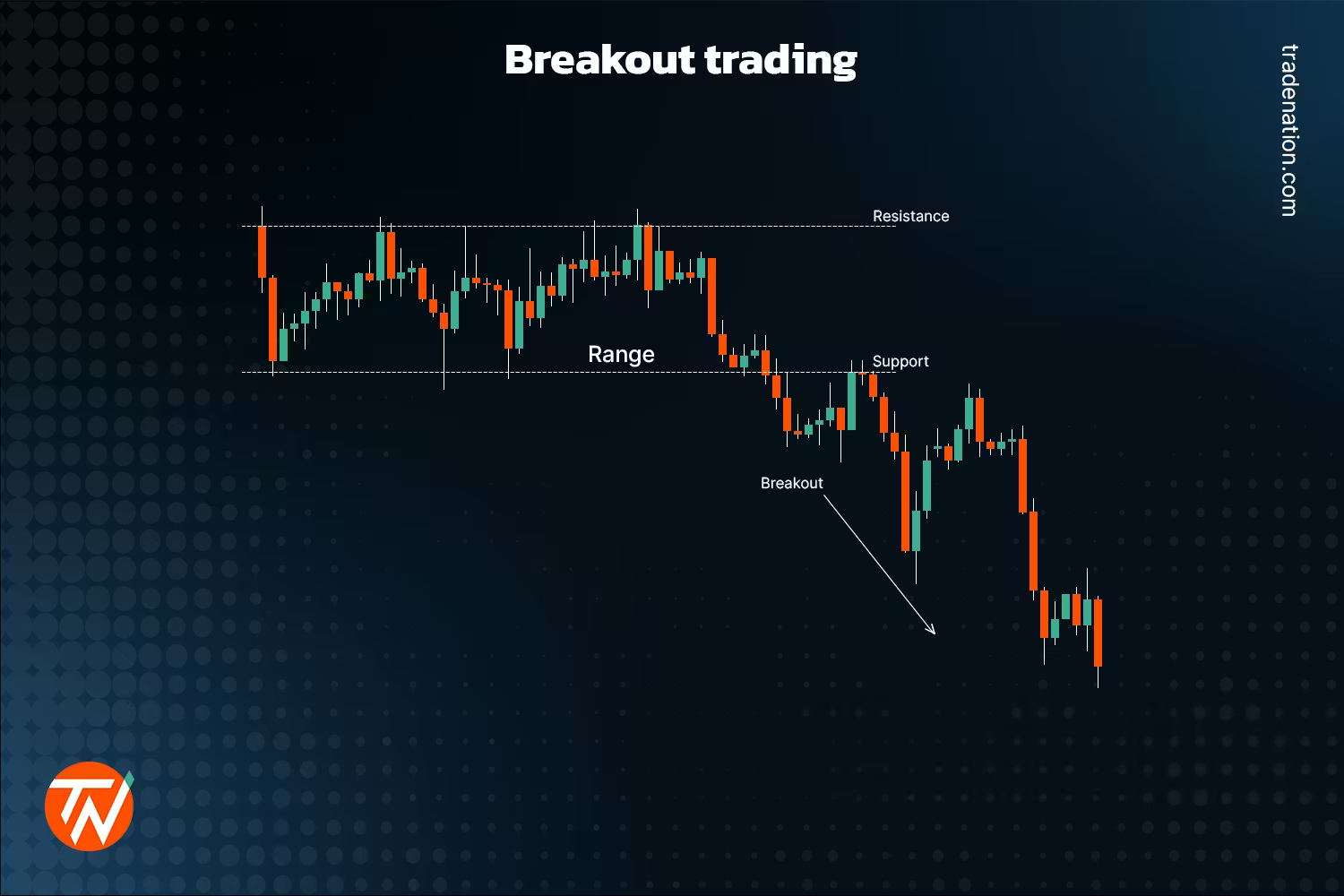
- Breakout strategies for volatility-driven entries
- Reversion strategies for mean-reverting markets
CEO Insight: Matching your style to your system ensures operational alignment and prevents impulsive decisions.
3. Evaluate Available Trading Systems
3.1 Publicly Available Systems
- Many systems are marketed online; due diligence is critical
- Check historical performance, credibility, and reviews
- Avoid systems promising unrealistic, guaranteed returns
3.2 Custom-Built Systems
- Design your system based on research, indicators, and personal analysis
- Advantage: full control, better alignment with your risk profile
- Disadvantage: requires more expertise and time
3.3 Algorithmic or Automated Systems
- Use automation to reduce emotional bias
- Evaluate execution speed, reliability, and data quality
- Ensure risk parameters are built-in
4. Key Metrics to Identify a Viable System
4.1 Performance Metrics
- Win rate and average trade profit/loss
- Maximum drawdown and capital risk
- Risk-adjusted returns (Sharpe ratio, Sortino ratio)
4.2 Consistency Across Market Conditions
- Test in bullish, bearish, and sideways markets
- System should perform robustly, not only under ideal conditions
4.3 Number of Trades and Statistical Significance
- Evaluate systems with sufficient trade volume for meaningful data
- Too few trades can misrepresent profitability
5. Backtesting and Demo Testing
5.1 Historical Backtesting
- Use accurate historical data
- Include fees, slippage, and market anomalies
- Avoid overfitting to past data
5.2 Demo Accounts
- Test in real-time conditions without risking capital
- Monitor system performance, execution, and psychological responses
5.3 Walk-Forward Testing
- Validate system on unseen data
- Ensures robustness and adaptability
6. Risk Management Considerations
- Limit risk per trade to a small percentage of capital (1–2%)
- Use stop-losses and position sizing to prevent catastrophic losses
- Consider worst-case scenarios and stress-test the system
CEO Insight: Risk management is the backbone of any viable trading system—profitability without control is unsustainable.
7. Evaluating System Credibility
- Verify provider licensing and regulatory compliance
- Check for verified track records
- Review client testimonials and independent audits
- Avoid systems that rely on hype, guarantees, or secrecy
8. Trial and Adaptation
- Start small with limited capital allocation
- Observe how the system performs under real market conditions
- Record every trade and adjust strategy cautiously
- Document lessons and refine rules iteratively
9. Psychological and Operational Discipline
- Stick to system rules regardless of short-term outcomes
- Avoid chasing losses or overtrading
- Maintain discipline in execution and review
CEO Perspective: Treat the trading system like a business process—repeatable, measurable, and governed by rules.
10. Scaling a Proven System
- Once validated, gradually increase capital allocation
- Monitor performance metrics continuously
- Diversify across instruments or strategies to reduce concentration risk
- Avoid exponential scaling without system verification
11. Continuous Learning and Market Adaptation
- Markets evolve; systems must adapt
- Attend professional courses, webinars, and stay informed about macro trends
- Regularly review system performance and incorporate lessons learned
CEO Insight: Continuous adaptation is like strategic business improvement—systems must evolve to remain profitable.
12. Conclusion
Finding a day trading system that works requires a disciplined, systematic, and data-driven approach. Key takeaways:
- Define objectives, markets, and trading style
- Evaluate system credibility and historical performance
- Backtest, demo test, and walk-forward test thoroughly
- Implement robust risk management and position sizing
- Stick to system rules and maintain psychological discipline
- Scale gradually and adapt continuously
“A profitable trading system is not about luck—it is about structured planning, disciplined execution, and strategic adaptation.”
Summary:
Find out the steps that would enable you to find a Day Trading System that works wonders for you and allow you to start from scrath and grow big with time.
Keywords:
Daytrading system
Article Body:
Trading with a system will dramatically improve your chances of making money in the markets.
The next challenge is to find a daytrading system that works. Today you have the chance to choose from more than 300 trading systems available. Unfortunately just 10% of them are trading profitably.
In the next three minutes I will present you the 10 Power Principles for Successful Day Trading Systems, which will help and support you in your research.
Principle #1: Few rules – easy to understand
It may surprise you that the best daytrading systems have less than 10 rules. The more rules you have, the more likely you “curve-fitted” your trading system to the past, and such an over-optimized system is very unlikely to produce profits in real markets.
It’s important that your rules are easy to understand and execute. The markets can behave very wild and move fast, and you won’t have the time to calculate complicated formulas in order to make a trading decision. Think about successful floor traders: The only tool they use is a calculator, and they make thousands of dollars every day.
Principle #2: Trade electronic and liquid markets
We strongly recommend that you trade electronic markets because the commissions are lower and you receive instant fills. You need to know as fast as possible if your order was filled and at what price, because based on this information you plan your exit.
You should never place an exit order before you know that your entry order is filled. When you trade open outcry markets (non-electronic) you might have to wait awhile before you receive your fill. By that time, the market might have already turned and your profitable trade has turned into a loss!
When trading electronic markets you receive your fills in less than one second and can immediately place your exit orders. Trading liquid markets you can avoid slippage, which will save you hundreds or even thousands of dollars.
Principle #3: Make consistent profits
You should always look for a trading system that produces a nice and smooth equity curve, even if in the long run the net profit is slightly smaller. Most professional traders prefer to take small profits every day instead of big profits every now and then. If you trade for a living, you need to pay your bills from your trading profits, and therefore you should regularly deposit profits into your trading account.
Making consistent profits is the secret of successful traders!
Principle #4: Maintain a healthy balance between risk and reward
Let me give you an example: If you go to a casino and bet everything you have on “red”, then you have a 49% chance of doubling your money and a 51% chance of losing everything. The same applies to trading: You can make a lot of money if you are risking a lot, but then risk of ruin is very high. You need to find a healthy balance between risk and reward.
Let’s say you define “ruin” as losing 20% of your account, and you define “success” as making 20% profits. Having a trading system with past performance results let you calculate the “risk of ruin” and “chance of success”.
Your risk of ruin should be always less than 5%, and your chance of success should be 5-10 times higher, e.g. if your risk of ruin is 4%, then your chance of success should be 40% or higher.
Principle #5: Find a system that produces at least five trades per week
The higher the trading frequency the smaller the chances of having a losing month. If you have a trading system that has a winning percentage of 70%, but only produces 1 trade per month, then 1 loser is enough to have a losing month. In this example, you could have several losing months in a row before you finally start making profits. In the meantime, how do you pay for your bills?
If your trading system produces five trades per week, then you have on average 20 trades per month. Having a winning percentage of 70% – your chances of a winning month are extremely high.
That’s the goal of all traders: Having as many winning months as possible!
Principle #6: Start small – grow big
Your trading system should allow you to start small and grow big. A good trading system allows you to start with one or two contracts, and then increase your position as your trading account grows. This is in contrast to many “martingale” trading systems that require increasing position sizes when you are in a losing streak.
You probably heard about this strategy: Double your contracts every time you lose, and one winner will win back all the money you previously lost. It’s not unusual to have 4-5 losing trades in a row, and this would already require to trade 16 contracts after just 4 losses! Trading the e-mini S&P you would then need an account size of at least $63,200, just to meet the margin requirement. That’s why martingale systems don’t work.
Principle #7: Automate your trading
Emotions and human errors are the most common mistakes that traders make. By all means you have to avoid these mistakes. Especially during fast markets, it is crucial that you determine the entry and exit points fast and accurately; otherwise, you might miss a trade or find yourself in a losing position.
Therefore you should automate your trading and look for a trading system that either already is or can be automated. Automating your trading makes it free of human emotion. The buy and sell operations are all automatic, hands-free, with no manual interventions and you can be sure that you make profits when you should according to your plan.
Principle #8: Have a high percentage of winning trades
Your trading strategy should produce more than 50% winners. There’s no doubt that trading systems with smaller winning percentages can be profitable, too, but the psychological pressure is enormous. Taking 7 losers out of 10 trades and not doubting the system takes great discipline, and many traders can’t stand the pressure. After the sixth loser they start “improving” the system or stop trading it completely.
Especially for beginners it is a big help to gain confidence in your trading and your system if you have a high winning percentage of more than 65%.
Principle #9: Look for a system that is tested on at least 200 trades
The more trades you use in your back testing (without curve-fitting), the higher the probabilities that your trading system will succeed in the future. Look at the following table:
Number of Trades 50 100 200 300 500 Margin of Error 14% 10% 7% 6% 4%
The more trades you have in your back testing, the smaller the margin of error, and the higher the probability of producing profits in the future.
Principle #10: Chose a valid back testing period
I recently saw the following ad: “Since 1994 I’ve taught thousands of traders worldwide a Simple and Reliable E-Mini trading methodology”.
That’s very interesting, because the e-mini S&P was introduced in September 1997, and the e-mini Nasdaq in June 1999, therefore, none of these contracts existed before 1997. What kind of e-mini trading did this vendor teach from 1994-1997???
The same applies to your back testing: If you developed an e-mini S&P trading strategy, then you should back test it only for the past 2-4 years, because even though the contract has existed since 1997, there was practically nobody trading it (see chart below):
Now you know how to separate the scam from good working trading systems. By applying this checklist you will easily identify trading systems that work and those that will never make it.
Author�s name
Markus Heitkoetter
Author’s Info:
Markus Heitkoetter is a 19 year veteran of the markets and the CEO of Rockwell Trading. For more free information and tips and trick how to make consistent profits with online daytrading, visit his website www.rockwelltrading.com.


Tinggalkan Balasan